

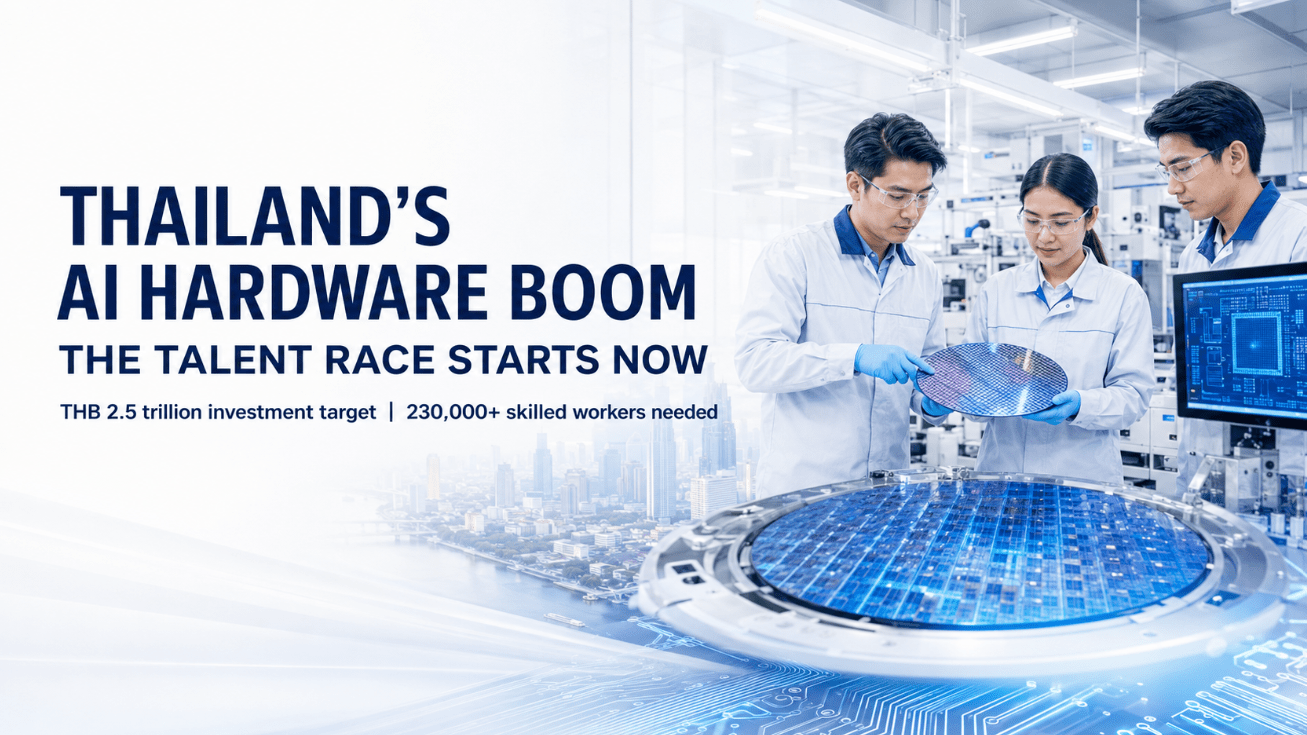
Thailand Is Already an AI Hardware Powerhouse. Now the Talent Race Begins.
Thailand is no longer simply talking about becoming part of the global AI economy. It is already deeply embedded in it.
The International Monetary Fund has identified Thailand alongside Taiwan, South Korea and Malaysia as the world’s four leading net exporters of AI-related hardware.
That is a significant position. It also changes the conversation.
The question is no longer whether Thailand can participate in the AI and semiconductor boom. The question is whether the country can turn its existing manufacturing strength into higher-value investment, technology transfer and skilled employment.
The government’s ambition is clear: move Thailand beyond traditional electronics production and assembly and establish the country as a regional hub for semiconductors, advanced electronics and AI-related infrastructure.
The opportunity is enormous. So is the hiring challenge.
What the IMF recognition actually means
The IMF’s definition of AI-related hardware includes selected computer equipment and components, processors and memory chips, and machinery used in semiconductor manufacturing. It does not mean Thailand is already a global leader in AI software or leading-edge chip design. It does show that the country occupies an important position in the technology supply chain at a time when global investment in AI infrastructure is accelerating. Thailand is not starting from zero. It already has:- A well-established electronics and automotive manufacturing base
- Strong experience in assembly, testing and advanced industrial production
- Growing demand from electric vehicles, data centres, energy systems and smart manufacturing
- An increasingly attractive position for companies diversifying their Asian supply chains
Thailand’s semiconductor targets are ambitious
Thailand’s long-term semiconductor strategy aims to attract more than THB 2.5 trillion in investment by 2050 and develop over 230,000 skilled workers. The strategy focuses on areas that connect naturally with the country’s existing industrial strengths, including:- Power semiconductors
- Sensors and analogue chips
- Photonics
- Integrated-circuit design
- Semiconductor assembly and testing
- Advanced electronics
- Wafer fabrication
The real constraint will be talent
Thailand wants to create more than 230,000 skilled semiconductor workers. Those people do not appear overnight. Demand is likely to rise across roles such as:- Process, product and equipment engineers
- Test, probe and validation engineers
- IC design and verification specialists
- Advanced packaging engineers
- Automation and smart-manufacturing professionals
- Facilities, cleanroom, energy and water-treatment engineers
- Quality, reliability and failure-analysis specialists
- Supply-chain and technical procurement professionals
- Engineering leaders and plant-management talent
- AI, data and cybersecurity specialists supporting advanced manufacturing
What employers should do now
Companies planning to invest or expand in Thailand should build their talent strategy at the same time as their operational plan. That means:- Map the talent market before finalising headcount. Understand which skills are available locally, where shortages exist and which roles may require regional or international searches.
- Build specialist pipelines early. Waiting until a facility is ready or a production deadline is approaching will make critical hiring slower and more expensive.
- Benchmark the complete offer. Base salary is only one part of the decision. Candidates will compare bonuses, allowances, insurance, provident fund, location, working pattern, training and long-term career value.
- Move quickly when the right person appears. Niche semiconductor candidates rarely remain available for long. Slow interview processes will lose talent.
- Develop, not only hire. Partnerships with universities, structured graduate programmes and technical upskilling will be essential if Thailand is to build a sustainable talent base.
What this means for candidates
For engineers and technology professionals, this could be one of Thailand’s most important career shifts in decades. Candidates with experience in electronics, automotive, energy, industrial automation, data centres or advanced manufacturing may already have transferable skills that semiconductor employers need. Now is the time to strengthen areas such as:- Semiconductor processes and manufacturing fundamentals
- Data analysis and statistical process control
- Automation and Industry 4.0 tools
- Quality and reliability methodologies
- English communication and cross-border stakeholder management
- Technical leadership and project ownership