

From Influence to Accountability: An Agile Coach’s Unexpected Journey Into Delivery Leadership
For years, I thrived as an agile coach, helping teams and leaders create great products through collaboration and experimentation. But recently, I found myself suddenly managing a large-scale SWIFT payments program for one of Asia’s biggest banks.
It wasn’t the role I expected—but the experience taught me invaluable lessons about influence, accountability, and navigating the messy reality of large-scale delivery.
This experience reminded me that coaching and delivery leadership aren’t opposites—they’re complementary. Sometimes, the best way to support change is to step into the arena yourself. And sometimes, the best lessons come when you’re out of your comfort zone.
Passion for Capability-Building
Anyone who has worked with me knows that I got into—and stayed in—agile coaching because I love helping people grow their professional skills. My aim has always been to help teams deliver better outcomes for their customers, more effectively and more harmoniously.
I know that might sound a bit corny. But for many people in the “traditional” organizations I work with, even thinking about what their customers’ value is, is a brand new conversation.
In many such environments, work feels like a series of instructions handed down from above. People aren’t encouraged to explore customer problems or create solutions—they’re expected to deliver pre-defined solutions created without their input.
The joy of coaching, for me, comes from watching people shift from being order-takers to becoming confident problem-solvers. Witnessing that transformation is exactly why I describe my work as something in which I thrived.
The “Accidental” Delivery Manager
I was hired by a specialized unit within a prominent tech consultancy to lead agile product delivery—at least, that was the plan.
By Day 11, however, I found myself asked to take charge of a delivery program that could generously be described as ‘in need of love’: timelines were elusive, coordination was aspirational, yet client milestones were approaching at remarkable speed.
Detective Work and Emphasis on Collaboration
As agile coaches, our superpower is listening before leaping into action—so I spent my first week playing detective. The biggest discovery?
We had dozens of talented people spread across at least ten teams worldwide, diligently working—but mostly in isolation. While most teams were aware of each other, decisions were often made locally, without considering the bigger picture. This led to suboptimal results, duplicated effort, and frequent confusion.
 |
| From: Siloed delivery |
Rather than declaring, “From now on, thou shalt collaborate,” I ran a retrospective—where, unsurprisingly, the teams concluded on their own: “Maybe we should collaborate more.”
From there, I simply helped them do it.
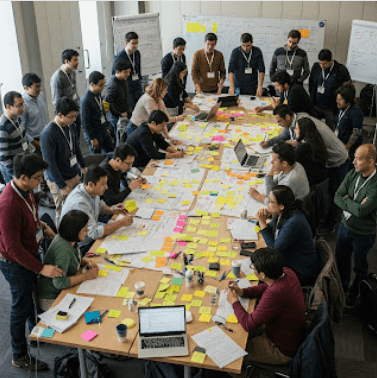
We started with a collaborative planning session that resembled a Quarterly Big Room Planning event. It produced a shared Program Board in Mural, which made dependencies visible and helped teams sequence their work more effectively.
 |
| To: Collaborative planning and execution |
Then we introduced a real, no-nonsense daily Scrum-of-Scrums. Within weeks, we were solving problems fast enough to convince even the skeptics that we might actually deliver on time.
The Outcomes
While the final program outcome is still pending, we’ve already seen meaningful progress. Several key milestones have been hit—some even ahead of the forecast I helped establish early on. [UPDATE: System went live on schedule without issues.]
More importantly, the organizational and cultural shifts we achieved may prove even more valuable:
- Faster problem-solving — Inter-team issues were resolved in minutes or hours, rather than weeks or months.
- No bottlenecks — In the previous approach, teams would rely on a central technical decision-maker to resolve these issues. In the new model, the right people would meet, discuss the root cause of the issue and make a collective decision on how to proceed.
- A culture of help — Teams felt safe raising problems openly, which fostered a shift from reactive blame to proactive support.
- Better, faster decisions — With full visibility into dependencies, teams started making decisions optimized for the whole program, not just their local scope.
- Improved morale and camaraderie — Collaboration became not only effective, but enjoyable. Team members began telling me how much better they understood the overall mission. And I rarely—if ever—had to tell anyone what to do. Once the intent was clear, people took full ownership of their work and moved forward with confidence.
Lessons Learned
When my role shifted, I could have pushed back or clarified what I was hired to do. Instead, I told myself: If I’m going to coach delivery managers, I’d better be able to walk the talk.
Fortunately, my coaching experience—and my software engineering experience—prepared me well.
As a delivery lead, I felt daily pressure, regular escalations, and a constant sense of personal accountability. Unlike coaching, where you play the long game, this was about delivering outcomes now.
Interestingly, I rarely had to issue instructions. By clearly defining problems, people naturally collaborated and self-organized to solve them. My role was to coordinate, facilitate, and remove obstacles—not to direct.
 |
| Trying to coach upwards…. |
What I didn’t anticipate was the loss of upward coaching. It was especially tough being micromanaged—something I would typically coach against. But this experience reinforced just how much organizational structure can shape (and sometimes distort) leadership behavior.
Advice for Agile Coaches Moving into Delivery Management
- Lean into Your Agile Strengths: Your listening, facilitation, and empowerment skills will serve you well—don’t abandon them; double down.
- Embrace Accountability, but Resist Micromanaging: Delivery demands outcomes. Lead with clarity and transparency, but trust your teams to own the how.
- Navigate Upward Dynamics with Empathy and Adaptability: One of the toughest shifts is losing your ability to coach upward. As you step into the chain of command, influencing senior leaders becomes more constrained—and sometimes, those same leaders may start to micromanage you. It’s tempting to push back, especially when the behavior contradicts everything you’ve coached. But resist the urge to react defensively. Instead, adapt your communication style, focus on building trust, and approach the situation with empathy. Recognize that these behaviors often stem from pressure and uncertainty, not intent to control. Holding your ground with grace, while modeling calm and clarity, can be your most powerful coaching stance—even when it doesn’t feel like coaching at all.
- Protect and Promote Collaboration: Encourage cross-team communication proactively. Visualize dependencies clearly and publicly (tools like Mural or Miro can help). The faster issues surface, the quicker teams can solve them—together.
- Stay Curious and Reflective: You’ll make mistakes. Reflect often, adjust quickly, and never lose your sense of humour. After all, agility is about responding positively to change—yours included.
Building out your delivery or technology leadership team in Thailand? Explore our executive search services or talk to Evantis Talent Solutions.